

Citric Acid Powder


- Regular price
-
$28.00 AUD - Regular price
-
- Sale price
-
$28.00 AUD
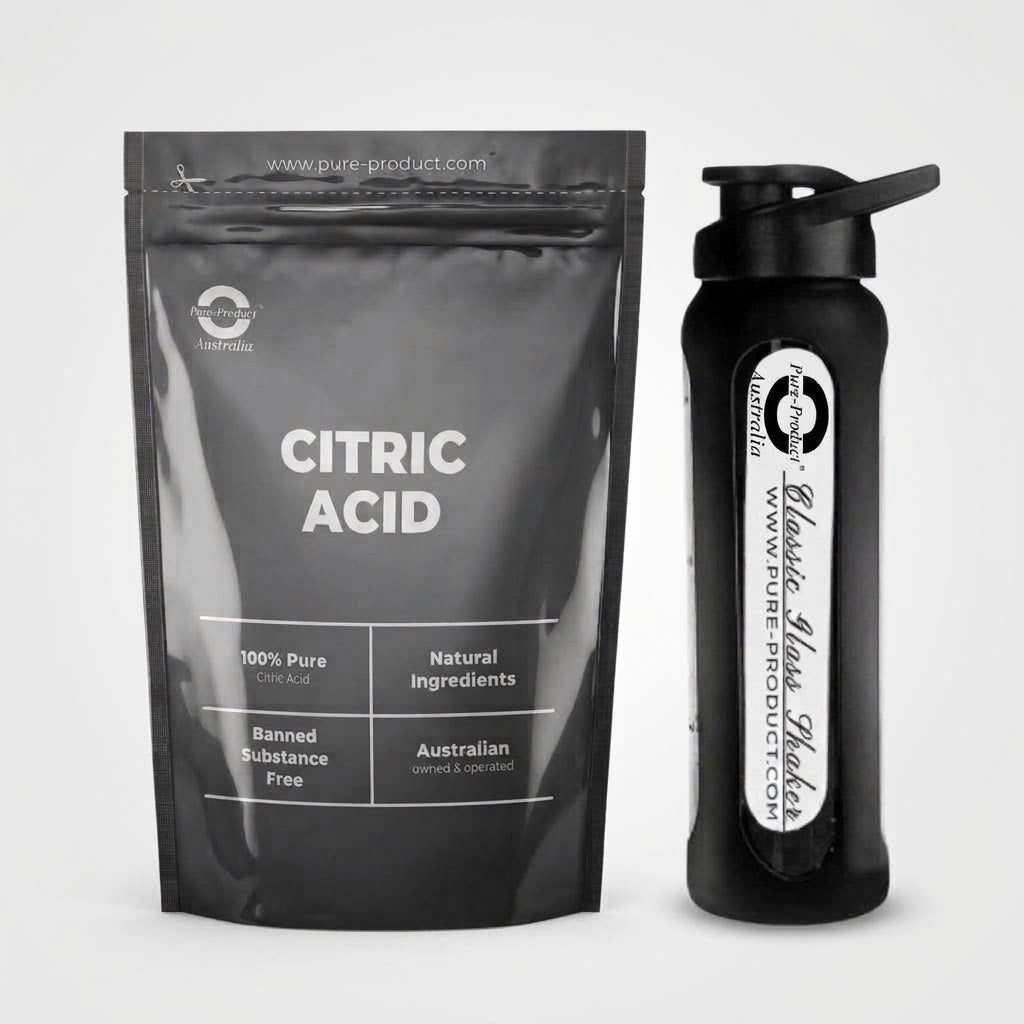
Can we offer you a glass shaker?
Choose one or both
Couldn't load pickup availability
Description
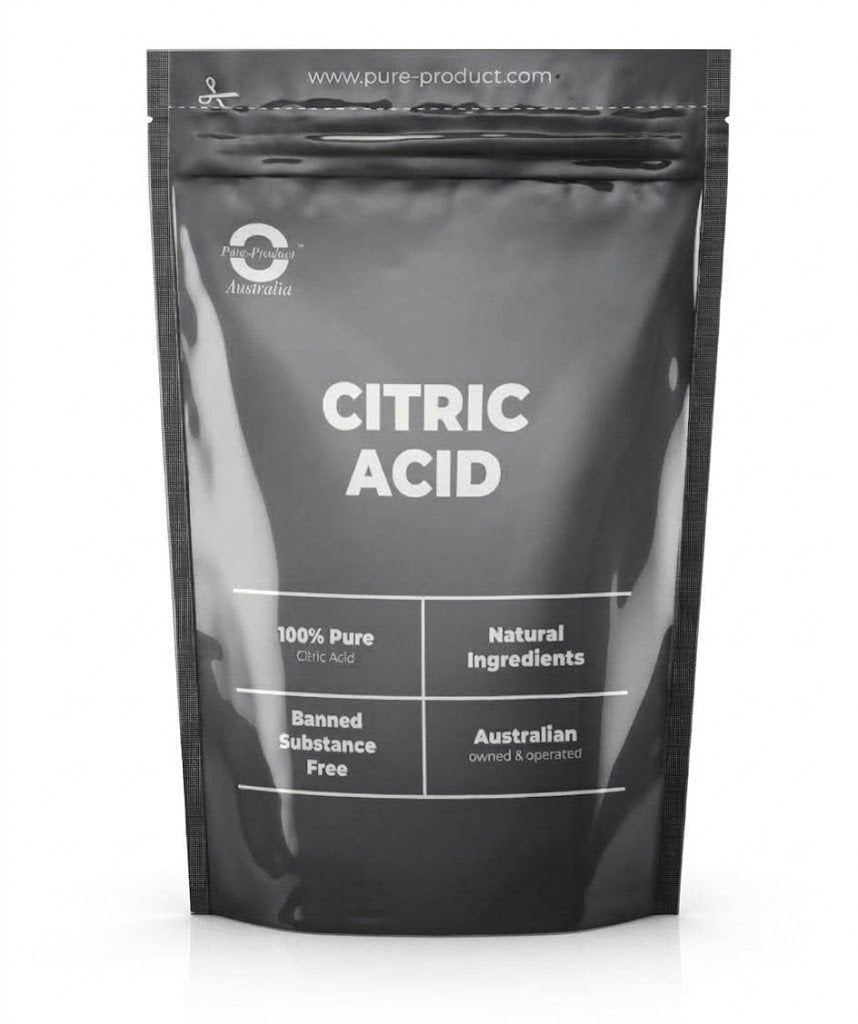
Citric Acid is a weak organic acid and natural preservative found in living cells, with the highest concentrations in lemons and limes. It is commonly used to add an acidic, sour taste to foods and drinks, and it appears here as a white crystalline powder.
Food-grade citric acid is versatile and can be used in many ways:
- As a lemon juice substitute in recipes (1/4 tsp citric acid is roughly equal to 1 tbsp lemon juice)
- As a natural preservative
- To add an acidic, sour taste to foods and soft drinks
- In home canning, cheese-making and bath products
- As an environmentally friendly cleaning agent
Citric Acid Powder is a pantry staple worth keeping on hand, useful well beyond the kitchen. Home brewers and cheese makers rely on it for consistent results, and many people use it alongside our natural flavour powders to sharpen and brighten the taste of a homemade drink or shake. Because it is a fine, food grade powder, it dissolves quickly and evenly, so only a small amount is needed at a time. Store your Citric Acid Powder in a cool, dry place, tightly sealed, to keep it free flowing and free from moisture. Pure Product Australia is an Australian company.
To reduce our environmental impact, we will no longer include plastic spoons. We request that you use a standard teaspoon to measure your serving size for this product.
Nutritional Information
Ingredients
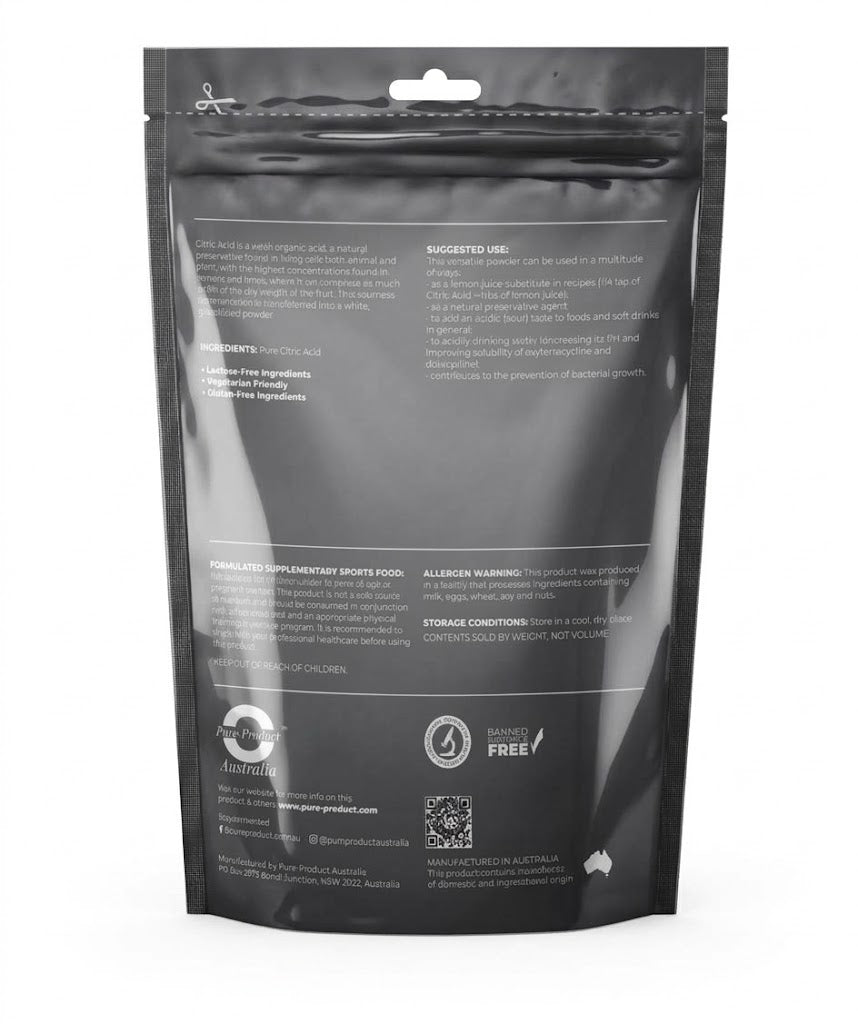
Pure Citric Acid.
- Lactose-Free Ingredients
- Vegetarian Friendly
- Gluten-Free Ingredients
Allergen Warning
This product was produced in a facility that processes ingredients containing milk, eggs, wheat, soy and nuts.
Storage Conditions
Store in a cool, dry place. Contents sold by weight, not volume.
Directions
Citric Acid is a versatile powder that can be used in a multitude of ways:
• as a lemon juice substitute in recipes (1/4 tsp of citric acid = 1tbs of lemon juice)
• as a natural preservative agent
• to add an acidic (sour) taste to foods and soft drinks in general
• to acidify drinking water (decreasing its pH and improving solubility of oxytetracycline and doxycycline)
• contributes to the prevention of bacterial growth
FORMULATED SUPPLEMENTARY SPORTS FOOD:
Not suitable for children under 15 years of age or pregnant women. Should only be used under medical or dietetic supervision. This product is not a sole source of nutrition and should be consumed in conjunction with a nutritious diet and an appropriate physical training or exercise program. It is recommended to check with your professional healthcare before using this product. KEEP OUT OF REACH OF CHILDREN.
Lab Testing Results
At Pure Product Australia, we take the purity of our products very seriously.
To keep our range consistently high quality, we send a cross-section of our products off for independent testing at ALS Laboratories, a global testing group with labs based right here in Australia. ALS is independently verified and NATA/TGA accredited, and its Australian labs are trusted by food producers, safety regulators and pharmaceutical manufacturers for exactly this kind of quality and safety testing.
ALS isn't just a supplements lab, either. Globally, it partners with companies like NUVISAN on pharmaceutical drug development and quality control, work that demands a much higher level of scientific scrutiny than most industries ever see. When a lab is trusted to support medicine development, you can be confident it's more than capable of accurately verifying what's actually inside a tub of protein.
Every test result we get back is a genuine, independently verified check of our products, not something we've cherry-picked or spun for marketing. It's how we make sure what's on our label matches what's actually in the bag, batch after batch.
For the latest test results, click here.
Frequently Asked Questions
How is this product packaged?
This product is supplied in resealable 200g and 500g bags, so if you purchase 1KG, you might receive 2 bags of 500g.
How does Citric Acid taste?
This product is unflavoured, but has a sharp, sour taste due to its natural acidity.
What is citric acid used for?
It is a food-grade acid used to add a sour taste, as a natural preservative, in home canning and cheese-making, and as a natural cleaning agent.
Can I use it instead of lemon juice?
Yes - about 1/4 teaspoon of citric acid is roughly equivalent to 1 tablespoon of lemon juice in recipes.
Is it food-grade?
Yes - it is a food-grade citric acid powder.
How do I store it?
Keep it sealed in a cool, dry place.
Has this product been tested?
We have strict quality control systems to ensure the highest quality and purity of the product. To see the latest results, send us a message.
Is this product made with Halal ingredients?
Yes, this product is made with Halal ingredients.
Is this product made with Kosher ingredients?
Yes, this product is made with Kosher ingredients.
Guides & Articles